Welcome to the world's largest skydiving center. Here's everything you need to know about what you're watching — from dirt dives to world records.
Welcome to Eloy
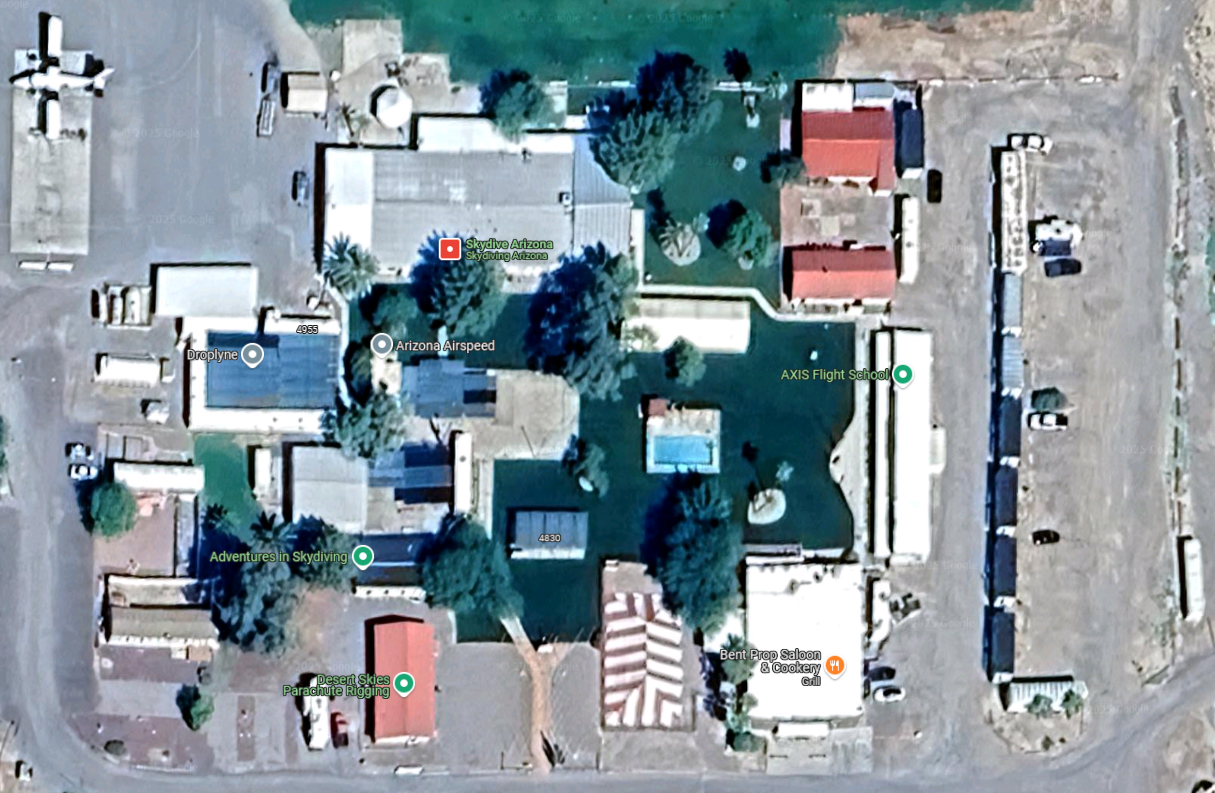
Skydive Arizona is spread across nearly 90 acres of pristine Arizona desert. For over 45 years, skydivers from every corner of the world have come here to train, compete, and break records. And you've got a front-row seat.
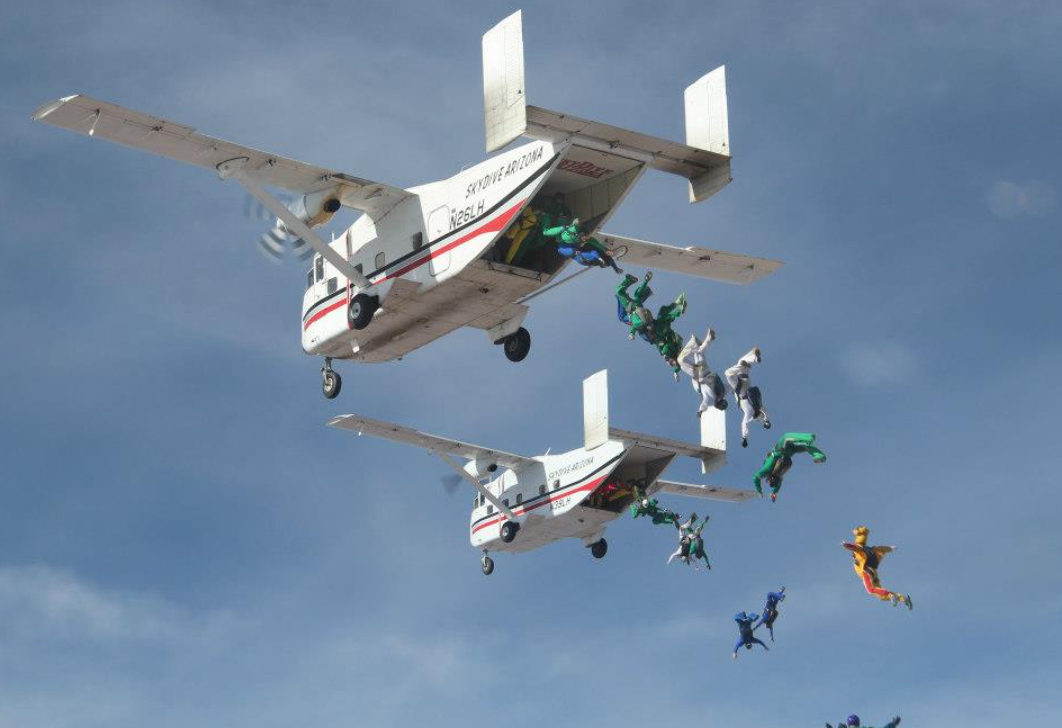
Skydive Arizona operates Skyvans and Twin Otters — each carrying up to 23 skydivers. On a busy day, you might see multiple planes taking off within minutes of each other, all fully loaded.
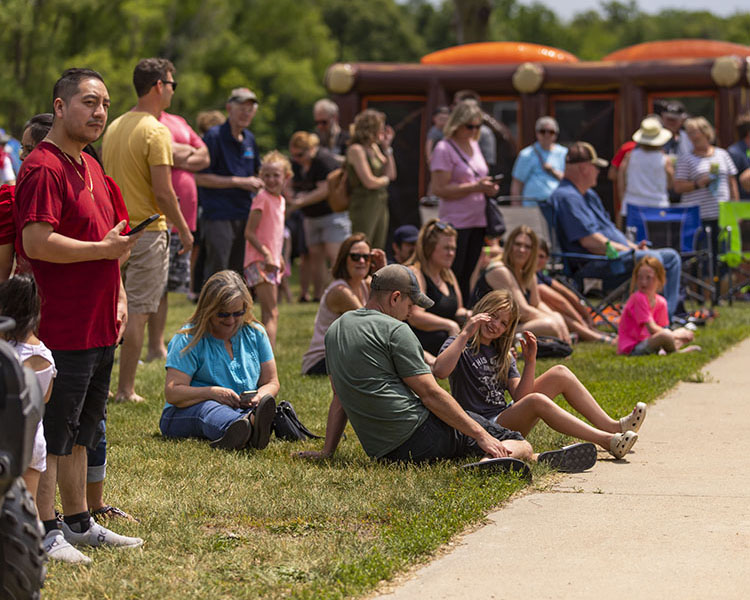
90-year-old Laura Bell Sullivan celebrated her birthday with a tandem skydive at SDAZ — with 45 family members watching from the ground.
▶ Watch on YouTube
Be Prepared
SDAZ is in the Sonoran Desert — come prepared and you'll have a much better time watching the action all day.
Bring folding camp chairs or low-back beach chairs. You'll be watching the sky for hours — give your neck a break. There's limited shade and seating, so bringing your own is essential.
Sunscreen (SPF 50+), a wide-brimmed hat, and sunglasses are non-negotiable. The Arizona sun is relentless, especially from October through April when events run.
Stay hydrated — bring a refillable water bottle and snacks. The Bent Prop Saloon serves food and drinks, but having your own supply means you won't miss any action.
A camera with a decent zoom or a pair of binoculars will let you watch formations build at altitude. Phones work great for canopy landings up close.
You'll be walking on grass, dirt, and gravel. Closed-toe shoes are recommended. Leave the flip-flops at home.
The Bent Prop Saloon and some vendors may be cash-only. An ATM is available on site, but having cash on hand keeps things easy.
Desert temperatures can swing 30°F+ between morning and afternoon. Bring a light jacket or hoodie for early mornings, especially during winter events. By midday you'll be back in a t-shirt.
The Experience
There's a lot happening above you. Here's a guide to understanding the full journey — from the moment skydivers kit up on the ground to the moment they touch down.
Every jump starts at manifest — the nerve center of the drop zone. Skydivers check in, get assigned a load (a plane full of jumpers), and organize their groups. You'll see them heading to the packing area — 51,000 square feet of indoor, climate-controlled space where parachutes are carefully folded and packed.
This is one of the coolest things to watch. Before a formation jump, skydivers rehearse their entire skydive on the ground. They'll lie on creepers (small wheeled boards), stand in circles, and physically walk through every grip, transition, and formation they plan to build at 120 mph.
For big-way formation loads, you might see 20, 40, or even 100+ people dirt diving together — moving in synchronized patterns across the grass. It looks like choreography because it is. Each person has a specific slot, a specific grip, and a specific timing.
Watch for: Organizers with clipboards, jumpers pointing at slot diagrams, and groups lying on the ground face-down doing "practice exits" together.
When you see skydivers heading to the aircraft, get ready. SDAZ operates two aircraft types — the Skyvan and the Twin Otter — and a fully loaded plane is a sight: up to 23 skydivers packed shoulder-to-shoulder, all strapped into parachute rigs, with helmets, goggles, altimeters, and cameras.
The ride to altitude (13,000–15,000 feet) takes about 15–20 minutes. The Skyvan has a massive rear ramp door — perfect for big formation exits. The Twin Otter loads from a side door. Both carry up to 23 jumpers per load. The door stays closed until jump run — then everything happens fast.
Watch for: Big smiles and thumbs-up on the way to the plane. These people are living their best lives.
Freefall lasts about 60 seconds from 13,000 feet. Skydivers fall at roughly 120 mph (belly-to-earth) or up to 180+ mph (head-down). You may need binoculars to catch the formations, but you'll see colorful canopies starting to deploy around 3,500–5,000 feet above the ground.
Listen for: The rush of freefall is silent from the ground, but you'll hear canopies snap open — a distinctive pop and flutter as the nylon catches air.
After opening, skydivers fly their canopies for 3–5 minutes back to the designated landing area. Experienced jumpers carve precise patterns in the sky — turning, flaring, and setting up their approach. Tandems (two-person rigs) fly larger, more docile canopies and land on the designated tandem area.
Watch for: Canopy formations — some jumpers stack up or fly side-by-side under canopy. It's beautiful to watch, especially at sunset.
The Disciplines
Skydiving isn't just "jumping out of a plane." There are multiple competitive and recreational disciplines, and you'll likely see several happening throughout the day.
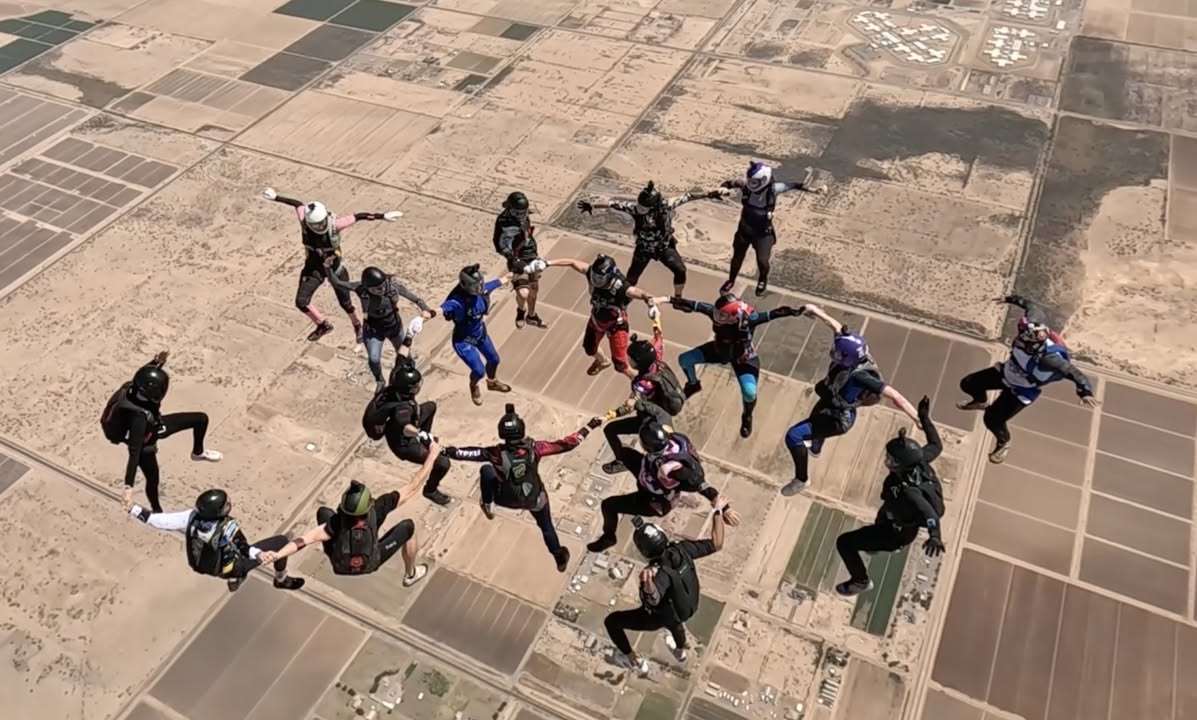
Teams of 4, 8, or even 100+ skydivers fall belly-to-earth and build geometric formations by gripping each other's arms and legs. Speed and precision matter — they're judged on how many formations they complete in a set time. This is the classic discipline you imagine when you think of skydiving.
Skydivers fall in upright or head-down positions at speeds up to 180+ mph. They perform acrobatic moves, transitions, and formations while oriented vertically rather than flat. It's fast, dynamic, and visually spectacular. Watch for Mixed Formation Skydiving (MFS) too — a hybrid of belly and freefly.
Dedicated camera flyers wear helmet-mounted cameras and fly around formations to document every jump. Much of the stunning skydiving footage you've seen online was shot by camera flyers right here at SDAZ. They need incredible flying skills to keep up while filming.
First-time skydivers are strapped to a highly experienced instructor and make the jump together. Tandems exit at 13,000 feet, freefall for about 60 seconds, then float under canopy to the tandem landing area. If you're thinking about jumping — this is how it starts!
The most visually dramatic discipline for spectators. Swoopers use high-performance parachutes to execute high-speed landings, carving across the ground (or a water pond) at incredible speed. These pilots are some of the most skilled in the sport. More on this below!
Skydivers wearing fabric "wings" between their arms and legs glide through the sky at high forward speeds, sometimes covering miles before deploying their parachute. From the ground, they look like human jets streaking across the sky.
Know Your Zones
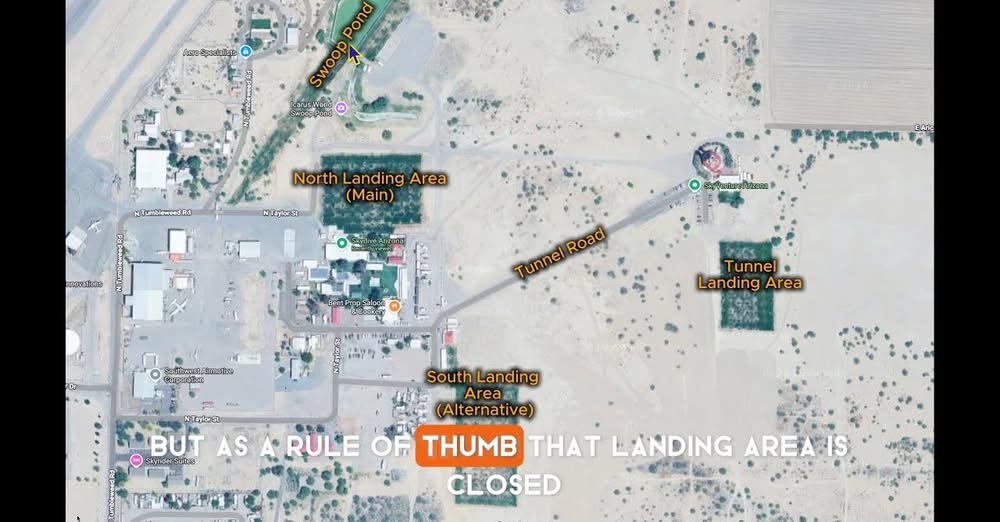
Three grass landing areas, a competition swoop pond, and designated tandem zones. Here's what to watch and where to stand.
Landing areas are active and canopies come in fast. Stay behind designated spectator boundaries. Never walk onto a landing area without permission. Skydivers have limited maneuverability close to the ground and may not be able to avoid you.
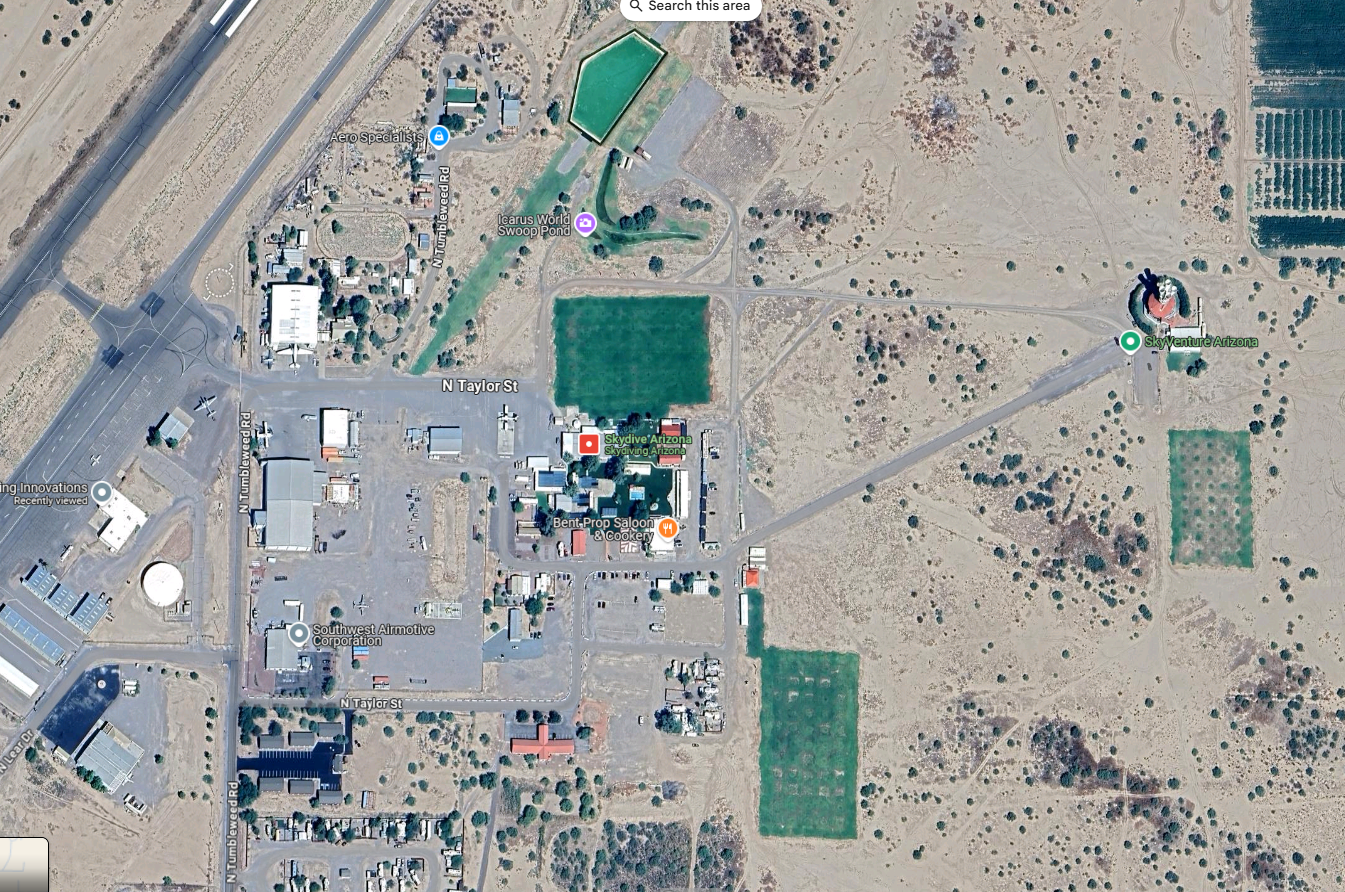
The main landing area (north field) is the closest landing area to the main spectator viewing areas and the Bent Prop restaurant. This is where you'll get the best view of canopy approaches and landings. Licensed jumpers land here throughout the day, and on busy days you'll see a steady stream of colorful canopies on final approach — it's mesmerizing.
The south landing field is designated for students and newer jumpers, who land here under the watchful eye of their instructors. It's separated from the main area to give students their own clear approach path without mixing into experienced traffic.
The competition-sized swoop pond is where canopy pilots practice speed, distance, and zone accuracy runs. Swoopers drag their feet through the water at high speed and land on the far side. During competitions, this is the epicenter of action — spectators gather around the pond to watch pilots carve through at speeds that seem impossible under fabric.
The Spectator's Favorite
This is the discipline that lands closest to you and is the most visually thrilling. Here's what's happening when you see a swooper carving across the ground at incredible speed.
A race against time and physics. Competitors navigate through laser-gated entry points at high speed, carving ultra-precise turns to reach the finish as fast as possible. At the top level, a tenth of a second separates podium from mid-pack.
Canopy pilots use every ounce of glide and energy to push their flight downrange after dragging water at entry. The best of the best ride that fine edge for over 200 meters. Efficiency is king — the pond becomes a runway to greatness.
After crossing entry, pilots drag a foot through up to four water gates, each adding points. Then they must land inside a target zone. The total score combines water gates and zone points, with penalties for anything less than a clean stand-up landing.
The most expressive discipline — part technique, part creativity. Competitors perform complex maneuvers inches above water: hook turns, switchbacks, foot drags, and controlled body inputs that transform swooping into visual poetry. No two runs ever look the same.
In September 2025, SDAZ hosted the 12th FAI World Cup of Canopy Piloting and the 3rd FAI World Cup of Canopy Piloting Freestyle, alongside the 6th FAI European Canopy Piloting Championships. Pilots from across the globe competed under one Arizona sky, with events scored using the InTime Digital Scoring System under FAI and ISC guidelines.
During swoop competitions, you'll see the Arizona Swoop League in action — meets feature Intermediate, Advanced, and Open class competitors across Zone Accuracy, Distance, and Speed events.
The Athletes
Some of the most decorated skydiving teams in the world call Skydive Arizona home. Here's who you might see training and competing.
One of the most legendary 4-way formation skydiving teams in history. Arizona Airspeed has dominated national and world competition for decades, stacking multiple USPA National Championship and World Championship titles. Their precision, speed, and teamwork are unmatched. They train year-round at SDAZ and at SkyVenture Arizona's wind tunnel.
Watch for: Airspeed athletes are regularly on the drop zone coaching, running tunnel camps (like the April 3–5 tunnel camp), and assembling for training blocks. When they dirt dive, you'll see four people moving with absolute synchronicity.
A top-tier 4-way freefly team competing in Vertical Formation Skydiving (VFS). While belly-flyers build formations face-down, freefly teams like Anthem work head-up and head-down — building intricate grips and sequences while flying vertically at 150+ mph. It's faster, more dynamic, and visually stunning. They train year-round at SDAZ and in the SkyVenture Arizona wind tunnel.
Watch for: A 4-person team exiting together and flying in tight vertical formations — head-down, head-up, and transitioning between orientations at high speed. Their tunnel sessions through the glass walls are mesmerizing.
Led by world champion competitors Niklas Daniel and Brianne Thompson, AXIS has been training skydivers in canopy control since 2010. They run B-License courses, accuracy camps, advanced accuracy training, and the PRO Rating Prep Course right here at Skydive Arizona.
Watch for: Groups of canopy students practicing precision approaches and accuracy landings, often with an instructor watching from the ground and debriefing each landing.
Flight-1 brings world-class canopy coaching to Eloy regularly, with courses led by instructors like Mel Firth. Their 101 "The Active Pilot" and 102 "Developing Our Range" courses teach everything from consistent landings to advanced canopy maneuvers. These courses satisfy USPA B-license canopy requirements.
The FliteShop runs MFS (Mixed Formation Skydiving) scrambles and freefly events at SDAZ. These events bring together head-up and head-down flyers for organized jumps, new partners every jump, and plenty of friendly competition. Great fun to watch from the ground as freeflyers move at incredible speeds.
Making History
Skydive Arizona has been the launching point for multiple world records. The combination of perfect weather, massive lift capacity, and world-class talent makes Eloy the go-to location when the sport pushes its limits.
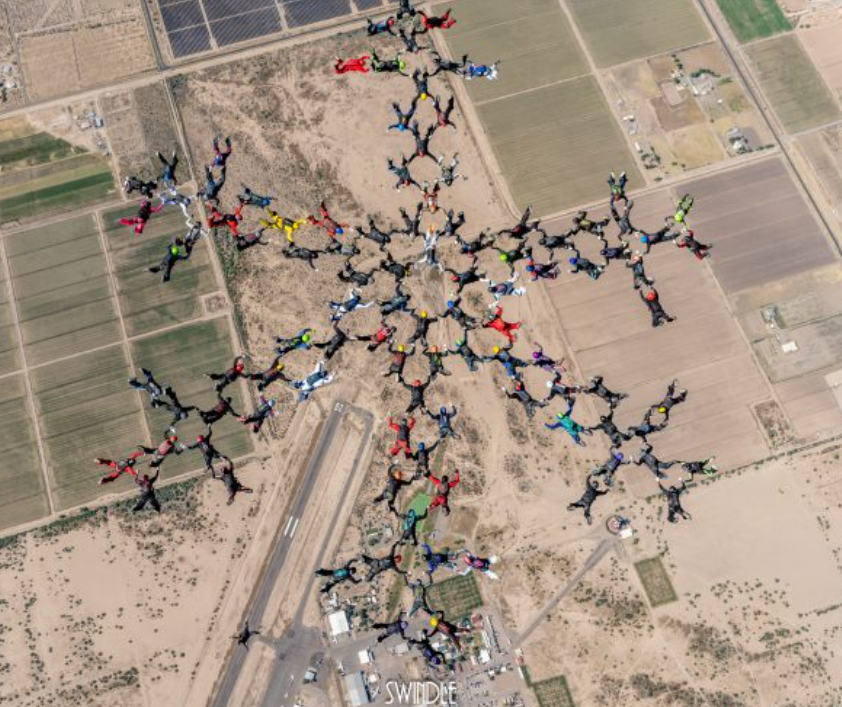
SDAZ has hosted numerous large formation records, where 100+ skydivers exit from multiple aircraft and build a single, interconnected formation in freefall. Every person must reach their precise slot — often in under 10 seconds — and hold the formation long enough for it to be "built" and documented by camera flyers.
Coming in November 2026: The Women's Upright World Record Attempts, organized by Amy Chmelecki, Domi Kiger, Sara Curtis, and Stephanie Strange. The goal: beat the 32-way Women's Upright record set in 2016. Training camps are running throughout 2026 right here at SDAZ.
From USPA Nationals to FAI World Cups, Skydive Arizona has hosted the world's top competitions across multiple disciplines. The swoop pond, wind tunnel, and aircraft fleet make it uniquely capable of running simultaneous events at scale.
Mark your calendar: the Women's Upright World Record Attempts will take place at SDAZ. This invite-only event will feature the world's best vertical flyers attempting to shatter the existing record. The lead-up training camps are open to men and women who want to sharpen their upright formation flying skills.
What's Coming Up
There's always something happening at SDAZ. Here are the key events — come watch world-class competition, or just soak in the energy of a boogie weekend.
Two days of indoor skydiving competition across FS, VFS, and MFS. Watch through the tunnel glass as flyers compete at high speed. Kids Challenge included!
Intermediate, Advanced, and Open class swooping — Zone Accuracy, Distance, and Speed. Watch canopy pilots carve across the pond at jaw-dropping speed.
101 "The Active Pilot" + 102 "Developing Our Range" — world-class canopy coaching on the drop zone.
International speed skydiving competition brings world-class athletes to the desert.
Immersive canopy skills weekend for advancing skydivers, led by Niklas Daniel and Brianne Thompson.
Led by Sara Curtis and Amy Chmelecki. Open to men and women looking to sharpen upright formation flying skills.
One of the most surreal experiences in skydiving. Watch illuminated canopies float down under the stars — it's magical even from the ground.
The main event. The world's best vertical flyers attempt to break the 32-way Women's Upright record set in 2016. History could be made right here.
Team Airspeed
Arizona Airspeed — one of the most dominant 4-way teams ever — trains regularly at SDAZ. Here's when you might catch them in action.
Annual invitational event at SDAZ
Coached 4-way flying at SkyVenture Arizona. Fly 2-on-2 with world champions or bring your full team for outside coaching.
Full week of training jumps at Skydive Arizona. Watch world-class 4-way practice from the ground!
Airspeed competes at Skydive DeLand, Florida
Another round of coached tunnel flying at SkyVenture Arizona
From Balloons to Big-Ways
What started as a death-defying leap from a hot air balloon is now a global sport with millions of jumps per year. Here are the milestones that got us here.
André-Jacques Garnerin made the first parachute jump in history, descending ~3,000 feet from a hot air balloon above Paris using a silk canopy. The age of human flight under fabric had begun.
Georgia "Tiny" Broadwick — a pioneering woman — became the first person to make a free-fall parachute jump while demonstrating for the U.S. Army. She manually deployed her chute, proving that humans could fall freely and survive. She was just 4'11" and weighed 85 pounds.
Captain Joseph Kittinger jumped from 102,800 feet (19.5 miles!) as part of Project Excelsior. He fell for 4 minutes and 36 seconds, reaching 614 mph. His right hand swelled to twice its normal size when his glove pressurization failed. He survived with nothing but courage and a drogue chute.
The first documented skydiving formation happened over Arvin, California — a 4-man star by Mitch Poteet, Don Henderson, Andy Keech, and Lou Paproski, photographed by Bob Buquor. This moment launched what would become the most popular competitive discipline in skydiving.
Gary Dupuis made the first tandem parachute jump in DeLand, Florida. Later, Ted Strong and Bill Morrissey perfected the modern tandem system, opening skydiving to millions of first-timers — including you, if you decide to jump today!
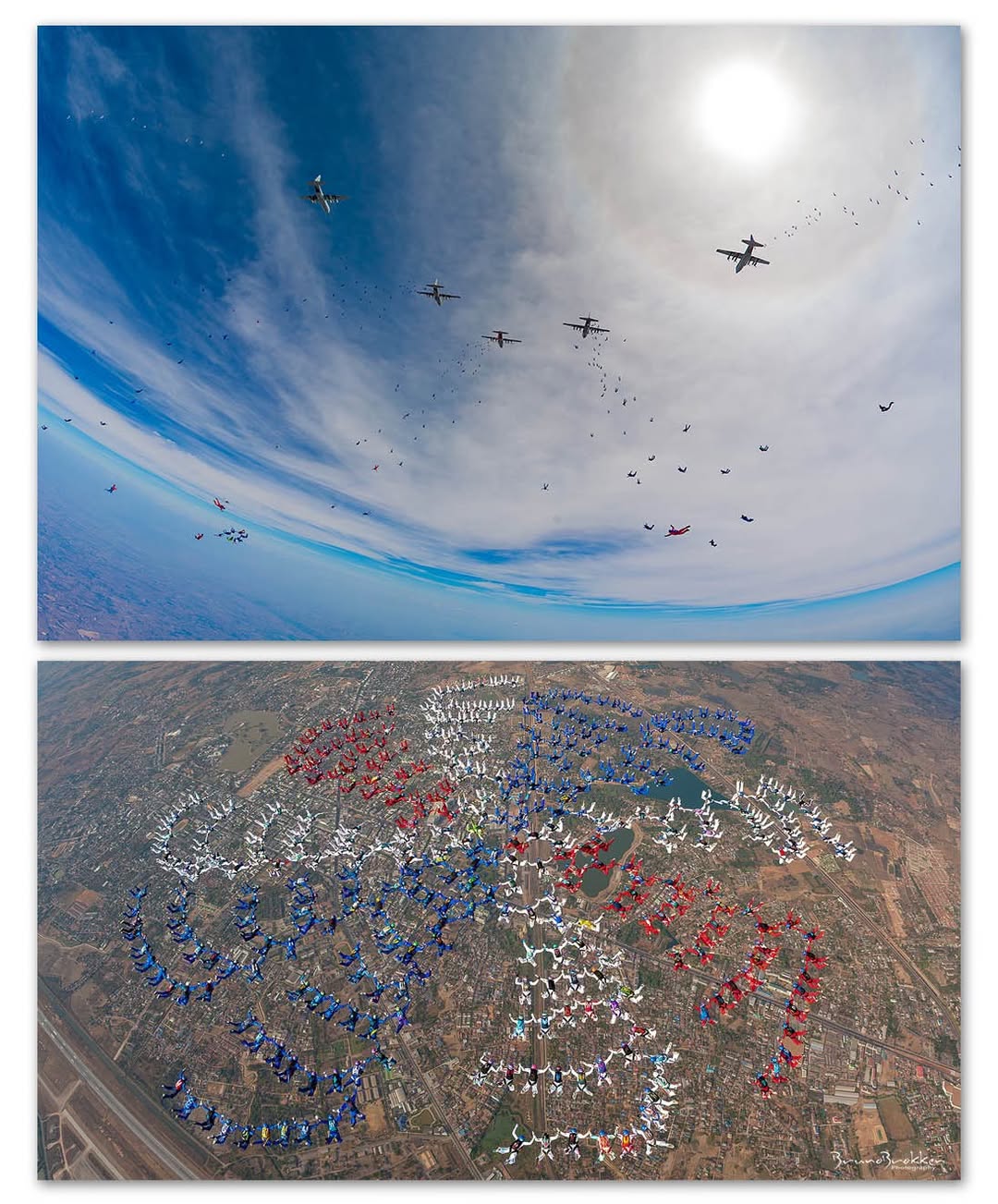
400 skydivers linked together in freefall over Udon Thani, Thailand — the largest formation ever built. Multiple SDAZ-based jumpers were part of this historic achievement. Imagine 400 people, all holding grips at 120 mph.
Felix Baumgartner jumped from 128,100 feet (24 miles) during the Red Bull Stratos mission, reaching Mach 1.24 — 834 mph — becoming the first human to break the sound barrier outside a vehicle. Kittinger himself was on mission control.
Alan Eustace (a Google VP) jumped from 135,908 feet — over 25 miles — falling for 4½ minutes with a drogue chute. He broke Baumgartner's altitude record with far less fanfare and no capsule — just a spacesuit attached to a helium balloon.
In 2024, USPA members made 3.88 million jumps in the U.S. alone. The sport has never been safer or more accessible. World championships span dozens of disciplines. Indoor wind tunnels let anyone experience freefall. And drop zones like SDAZ continue to push what's possible.
The Drop Zone That Changed Everything
From humble desert beginnings to the largest skydiving center on the planet — the 45+ year journey of SDAZ is as remarkable as the sport it helped shape.
Eloy Municipal Airport opens in the small cotton-farming town of Eloy, Arizona — a name derived from "East Line Of Yuma," the old railroad designation from 1902. The desert terrain offered unlimited visibility, calm winds, and wide-open airspace — a combination that would prove irresistible to skydivers.
Skydiving operations begin in the Eloy area. The clear skies, 300+ jumpable days per year, and affordable land attract a growing community of sport jumpers and instructors to the Sonoran Desert. What starts as a modest operation will soon grow into something unprecedented.
Skydive Arizona officially establishes its home at Eloy Municipal Airport. The dream: build the world's premier skydiving facility right in the heart of Arizona's Pinal County. With year-round sunshine, vast desert landing areas, and proximity to Phoenix and Tucson, the location is perfect.
SDAZ grows relentlessly — adding aircraft, expanding facilities, and attracting world-class competitors. The fleet grows to include Twin Otters, Skyvans, and even a Douglas DC-3. Three grass landing areas are built. The facility becomes a magnet for record attempts, world championships, and military training programs.
Spanning nearly 90 acres, Skydive Arizona is the largest skydiving center in the world. The fleet includes four Twin Otters and seven Skyvans. The campus features a 14-foot wind tunnel, 51,000 sq ft of indoor packing space, a swoop pond, swimming pool, the Bent Prop Saloon, lodging, rigging loft, gear store, and a wellness center. SDAZ employs 70 people — making it the 7th largest employer in Eloy.
Eloy is home to two parachute manufacturers — Firebird USA and Sun Path Products — making the town a true epicenter of the skydiving industry. Gear is literally designed and built in the same town where it's tested.
Eloy, Arizona proudly bills itself as the "Skydiving Capital of the World" — and the numbers back it up. With 30,000 aircraft operations per year at the airport (82 per day), the skies above Eloy are among the busiest in sport aviation.
The Sonoran Desert climate delivers more than 300 jumpable days per year — virtually unmatched anywhere in the world. Low humidity, minimal cloud cover, and mild winters make Eloy a 12-month skydiving destination.
Where Warriors Train
The skies above Pinal County aren't just for sport skydivers. U.S. Special Operations Forces and military units have trained in this region for decades — from WWII-era airfields to modern HALO/HAHO operations at SDAZ.
Skydive Arizona provides full facility support for military free-fall proficiency training, from indoor skydiving in the wind tunnel to high-altitude operations. SDAZ supports both HALO (High Altitude, Low Opening) and HAHO (High Altitude, High Opening) training — the two primary techniques used by U.S. Special Operations Forces for covert insertion behind enemy lines. The 90-acre facility, three landing areas, and 300+ jumpable days make it an ideal year-round military training venue.
Jumpers exit the aircraft at extreme altitude (15,000–35,000 ft), free-fall at terminal velocity reaching 126 mph, and deploy their parachute as low as 3,000 ft. The high speed and minimal canopy time defeats radar and reduces visibility to ground observers. Used by Green Berets, Navy SEALs, Rangers, and Delta Force for covert insertion of personnel and equipment.
Jumpers exit at high altitude and deploy their canopy immediately, then navigate using GPS or compass for distances of 40+ miles under canopy — sometimes for 30+ minutes. Teams stack in formation and follow a lead navigator to the landing zone. This allows troops to infiltrate from aircraft that never enter enemy airspace. SDAZ's vast landing areas are perfect for this long-glide training.
SDAZ sits in a region with deep military aviation roots. Several airfields in Pinal County support ongoing Department of Defense operations:
Built in 1941 as Coolidge Army Airfield — a WWII Army Air Corps training school. During the war, it served as Williams Auxiliary Field No. 3 for pilot training. After the war, the USAF used it for T-37 jet trainer operations from 1962 to 1992. Today, CPS — a private DoD contractor — conducts parachute jump training at the airport, and units from Davis-Monthan Air Force Base periodically use Coolidge for equipment drops. The airport spans 1,268 acres with two runways and handles 56,050 operations per year.
A regional airfield in the Pinal County area used for military parachute training operations. The remote desert setting and uncontrolled airspace make it an ideal location for military free-fall and static-line jump training. Combined with Coolidge and SDAZ, it forms part of a network of training facilities that make this region one of the most active military parachuting corridors in the country.
Home of Skydive Arizona since 1991. Opened in 1969, the airport handles 30,000 aircraft operations per year — 82 per day — with 99.5% general aviation and 0.5% military. The airport's FAA identifier is E60, and its uncongested airspace up to 18,000 feet is shared between sport skydivers and military training operations, making it one of the busiest skydiving airports on Earth.
The first combat HALO jump in history was performed by a MACV-SOG team in 1970 during the Vietnam War — they jumped from a C-130 at 18,000 feet into Laos. Captain Joseph Kittinger — who made his famous 102,800-foot jump during Project Excelsior in 1960 — helped pioneer the high-altitude techniques that military units still train on at facilities like SDAZ today.
Trailblazers
From the very first free-fall to modern world records, women have been at the forefront of skydiving's most daring achievements. Many of them trained and competed right here at SDAZ.
The first woman — and first person — to make a free-fall parachute jump (1914). Standing just 4'11", she performed for the U.S. Army and proved that manual deployment was possible. She literally invented the concept of modern skydiving before it had a name.
Holds the record for most parachute descents by a woman — 20,000+ jumps. She also set the record for most jumps by a woman in 24 hours (352). A U.S. Army Golden Knight, National Champion in accuracy, and one of the most accomplished competitors in the sport's history.
SDAZ local, world-class camera flyer, and organizer of the upcoming Women's Upright World Record attempts in November 2026. She was featured in the Chevy Sonic Super Bowl commercial filmed at Skydive Arizona and continues to push women's records forward.
Co-organizer of the Women's Upright World Record, Amy is one of the most accomplished freefly competitors in the world. She helps run the training camps at SDAZ that prepare flyers for the record attempts — turning individual talent into synchronized formations.
World champion competitor and co-founder of AXIS Flight School at SDAZ. Brianne coaches skydivers of all levels in canopy control and has been instrumental in advancing canopy education across the sport.
In 2009, 181 women from 26 countries jumped from nine planes at 17,000 feet and built the world's largest female-only formation — a moment that proved women's big-way skydiving was here to stay. Multiple SDAZ jumpers participated.
The Women's Upright World Record Attempts (Nov 23–27, 2026) will try to break the 32-way Women's Upright record set in 2016. Organized by Amy Chmelecki, Domi Kiger, Sara Curtis, and Stephanie Strange. Training camps run throughout the year at SDAZ — you might see them practicing while you're here!
The Legends
The International Skydiving Museum & Hall of Fame, located in Orlando, FL, recognizes the sport's most remarkable individuals. Several have direct ties to Skydive Arizona.
Founding member and former captain of Arizona Airspeed. The most decorated competitive formation skydiver of his era, with 66 gold medals in national and international competition. Key figure in setting the 300-way world record at Eloy, AZ, and the 400-way world record in Thailand.
World champion skysurfer turned Hollywood stunt cinematographer. Coordinated aerial stunts for major productions including Super Bowl commercials filmed at SDAZ. The documentary "Space Cowboy" tells his story — it's screening now!
USAF Captain who jumped from 102,800 feet in 1960 — the "highest step in the world." Set records for highest balloon ascent, highest parachute jump, and fastest speed through the atmosphere. Later served as Felix Baumgartner's mission control advisor for Red Bull Stratos.
Credited with inventing and perfecting the modern tandem parachute system — the very system that lets first-time skydivers jump safely with an instructor. Without them, you couldn't book a tandem at SDAZ today.
The International Skydiving Museum & Hall of Fame is being built near Orlando, Florida. The 2026 Hall of Fame Celebration takes place November 5–7, 2026. Learn more →
Gear Guide
That backpack-looking thing? It's a $8,000–$15,000 life-saving machine. Here's what every skydiver is wearing when they head to the plane.
The "backpack" that holds everything. It's custom-fitted to each skydiver and contains both the main and reserve canopies. The harness wraps around the legs, chest, and shoulders. Modern containers are sleek, colorful, and built to withstand thousands of jumps. Major brands include UPT (Vector), Sun Path (Javelin), Mirage, and Aerodyne (Icon).
The primary parachute. Modern parachutes are rectangular "ram-air" canopies — not the round ones you see in movies. They're essentially fabric wings with cells that inflate with air, giving the skydiver full directional control. Sizes range from large docile student canopies (~230 sq ft) to tiny high-performance "pocket rockets" (~67 sq ft) used by swoopers. Major manufacturers: Performance Designs, NZ Aerosports (Icarus), Aerodyne, Fluid Wings.
The backup chute. Required by FAA regulations — every skydiver wears two canopies. Reserve parachutes are built and tested to more exacting standards than mains. They must be inspected and repacked by an FAA-certified parachute rigger every 180 days whether used or not. In 2024, approximately 1 in 764 jumps required a reserve deployment.
A small computer inside the rig that measures altitude and speed. If it detects that the skydiver is still in freefall below a certain altitude (typically ~750 feet), it automatically fires the reserve canopy. Think of it as the ultimate backup to the backup. The most popular brand is Cypres, made in Germany. AADs have saved thousands of lives.
Worn on the wrist or chest-mounted, these show current altitude. Digital altimeters display the number; analog ones have a needle that sweeps counter-clockwise as you descend. Many skydivers also wear audible altimeters inside their helmets that beep at preset altitudes (breakoff, deployment, decision altitude).
Helmets range from open-face leather to full-face carbon fiber with built-in camera mounts. Goggles protect eyes at 120+ mph wind. Jumpsuits are specialized by discipline — formation skydiving suits have "grippers" on arms and legs for building formations. Freefly suits are tighter to reduce drag. Wingsuit pilots wear full fabric wings between arms and legs.
Helmet-mounted GoPros, Insta360s, and even professional RED cameras for film work. Camera flyers at SDAZ have shot footage for Super Bowl commercials (Chevy Sonic, Pepsi), NVIDIA stunts, and BF Goodrich tire drops. The camera gear is custom-mounted with quick-release cutaway systems for safety.
A complete new rig (container + main + reserve + AAD) costs roughly $8,000–$15,000. Many skydivers buy used gear, which can be significantly less. Equipment is built to last and often enjoys several owners before retirement. The Square 2 Gear Store right here at SDAZ carries gear and souvenirs!
The Science
For the curious minds — here's what's actually happening when a human body falls from 13,000 feet.
A falling human doesn't keep accelerating forever. Air resistance builds until it equals the force of gravity — that's terminal velocity. In a belly-to-earth position, the large surface area creates more drag, slowing you to ~120 mph. Go head-down and you cut through the air faster: 160-180+ mph. Wingsuiters can trade vertical speed for forward glide, covering miles horizontally.
A modern parachute isn't a drag device — it's a wing. Air rams into the front of the canopy cells, inflating them into an airfoil shape. This generates lift, just like an airplane wing. By pulling left or right toggles, the skydiver changes the shape of the trailing edge, turning the canopy. The "flare" at landing is like an airplane's landing flare — pulling both toggles converts forward speed into lift for a soft touchdown.
Canopy pilots use a hook turn — a steep turn close to the ground that trades altitude for speed. Physics converts gravitational potential energy into kinetic energy. The smaller the canopy and steeper the turn, the more speed they generate. Top swoopers can reach 60+ mph ground speed while skimming inches above the surface. The swoop pond gives them margin for error — water is more forgiving than dirt.
In formation skydiving, everyone must fall at the same speed. Lighter skydivers wear weight belts; heavier ones wear baggier suits. The real skill is relative work — making tiny body adjustments to control fall rate, forward/backward movement, and turns, all while matching 3 to 400 other humans falling through turbulent air at 120 mph.
Around the World
Skydive Arizona is the biggest, but it's part of a global community of legendary drop zones. Here's how SDAZ stacks up alongside the world's best.
The one you're at! World's largest skydiving center. 90 acres, world's largest aircraft fleet, 240 skydivers aloft at once, on-site wind tunnel, swoop pond, restaurant, and decades of world record history. The mecca of the sport.
The East Coast's premier DZ, located in Florida. Home to major competitions and the birthplace of tandem skydiving. DeLand and Eloy are the two titans of American skydiving — where Airspeed competes at the Shamrock Showdown.
Southern California's legendary drop zone. Home to the 100-person wingsuit formation world record (2012). Features a wind tunnel and hosts world-class training camps and competitions year-round.
Midwest powerhouse and home of the 164-way head-down world record (2015). Known for massive boogies, Summerfest, and an incredibly welcoming atmosphere for jumpers of all levels.
The largest skydiving center in the Southern Hemisphere and second-largest in the world. Brazil's skydiving community is massive, and Boituva has hosted numerous South American records and competitions.
Site of the 400-way world record (2006) — the largest formation ever built in freefall. The warm Thai air and massive airspace make it perfect for the giant multi-plane operations required for big-way records.
One of the leading DZs on the African continent. South Africa has a thriving skydiving scene with competitions, big-way events, and year-round jumping weather.
One of the UK's busiest drop zones and home of the world record for most tandem jumps in 24 hours (403, set in 2015). British skydiving has a passionate community despite the weather!
Skydiving is practiced in over 50 countries with national organizations affiliated with the FAI (Fédération Aéronautique Internationale). World Championships are held every two years across dozens of disciplines. The USPA alone has 41,000 members making 3.88 million jumps per year.
The Global Scene
A "boogie" is a skydiving festival — part competition, part reunion, part party. Every year, thousands of skydivers travel the globe to chase records, compete for national titles, and share the sky with friends old and new. Here are some of the biggest events on the calendar.
The United States Parachute Association National Championships are the premier domestic competition, crowning U.S. champions across every discipline — Formation Skydiving, Vertical Formation Skydiving, Artistic Events, Canopy Piloting, Wingsuit, Speed Skydiving, and more.
In 2026, the main competition returns to Skydive Perris in Southern California (September 2–20), while Canopy Piloting events head to Skydive City in Zephyrhills, Florida (September 22–28) and Accuracy lands at Skydive Phoenix in Maricopa, Arizona (October 27–31).
Hundreds of teams compete across three weeks. For spectators, the 4-way and 8-way Formation Skydiving rounds are the most exciting — teams exit the aircraft, build as many formations as possible in 35 seconds, and are scored by video judges on the ground.
Skydive Chicago in Ottawa, Illinois — operating since the early 1980s — hosts one of the Midwest's biggest annual boogies. Summerfest draws jumpers from across the country for big-way attempts, load organizing, coaching camps, and legendary parties under the Midwestern sky.
SDC is no stranger to records: in 2015, it hosted the 164-way head-down vertical world record. The DZ runs Skyvans, Otters, and King Airs, and offers a spectator-friendly atmosphere with viewing areas, a pro shop, and on-site camping.
Skydive Perris in Southern California celebrates 50 years of operation with a massive anniversary event on October 31 – November 1, 2026. Led by General Manager Dan Brodsky-Chenfeld — a six-time world champion with over 30,000 jumps — Perris is one of the most iconic DZs on the planet.
The facility boasts an on-site wind tunnel, the famous Bombshelter Bar & Grill, Hollywood filming connections (it's the go-to DZ for movies and TV), and year-round California weather that keeps the loads turning. Perris also hosts the P3 sequential big-way events, where teams of 40–100+ jumpers build multiple formations on a single skydive.
The Fédération Aéronautique Internationale (FAI) sanctions the World Parachuting Championships, held every two years in a rotating host country. Known informally as the "Mondial" when multiple disciplines compete at the same event, it's the Olympics of skydiving.
Dozens of countries send national teams to compete in Formation Skydiving, Canopy Piloting, Artistic Events, Wingsuit Flying, Speed Skydiving, and more. The competition brings together the absolute best in the world — and attending as a spectator is a once-in-a-lifetime experience.
Paraclete XP in Raeford, North Carolina — adjacent to Fort Liberty (formerly Fort Bragg) — operates one of the largest wind tunnels in the world and hosts major indoor skydiving (bodyflight) competitions year-round.
Indoor competitions feature the same disciplines as outdoor — 4-way Formation Skydiving, Vertical Formation Skydiving, Dynamic flying, and Freestyle — but in a controlled, spectator-friendly 14-foot recirculating tunnel. Teams train here for months before outdoor nationals. Paraclete's military roots (it's a training site for Army and Special Forces) add to the intensity.
Many drop zones host Christmas Boogies and New Year's events during the holiday season. Skydive Arizona's annual holiday boogie draws hundreds of jumpers who escape the cold for warm desert skies, load-organized big-ways, and Santa hats in freefall.
Skydive DeLand in Florida hosts the Shamrock Showdown each spring — a competitive event combined with a St. Patrick's Day boogie that fills every hotel in town. DeLand also hosts the Turkey Meet every Thanksgiving — one of the oldest continuous skydiving competitions in the U.S.
Bridge Day at the New River Gorge in West Virginia is the largest extreme-sports event in the world. Every October, BASE jumpers (Building, Antenna, Span, Earth) leap from the 876-foot-high bridge. While technically BASE jumping rather than skydiving, it draws the same community and spectating is spectacular — 80,000+ people line the gorge to watch.
Other notable global events include Equinox Boogie in Toogoolawah, Australia; the Vector Festival in Empuriabrava, Spain (Europe's largest DZ); and organizer-led big-way camps at Skydive Sebastian in Florida, where sequential formation records are regularly attempted over the Atlantic coast.
Most boogies are spectator-friendly — you don't need to be a jumper to attend. Check each DZ's website for event dates. The best spectating is at big-way events (huge formations overhead), canopy piloting competitions (swooping at 70+ mph past you), and night jumps (skydivers descend with LED lights and pyrotechnics). SDAZ's own events calendar is packed — check the Events section above.
Perspective
A few stats to blow your mind while you watch.
Most lifetime jumps by one person — Don Kellner, who made his last 8 jumps at age 85 in 2021.
Age of the oldest tandem skydiver — Irene O'Shea of Australia, who jumped in 2018 to raise money for Motor Neuron Disease.
Most jumps in 24 hours — Jay Stokes. That's one jump every ~2.25 minutes for an entire day.
Fastest speed by a skydiver — Felix Baumgartner, Mach 1.24, breaking the sound barrier during Red Bull Stratos in 2012.
Largest formation ever built in freefall — 400 skydivers linked together over Thailand in 2006.
Grandma Go Go (Laura Bell Sullivan) jumped at SDAZ for her 70th, 80th, and 90th birthdays. She's a local legend.
Talk Like a Skydiver
You'll hear these terms all day. Here's a quick glossary so you can follow along like a local.
Fuel Up
You don't need a parachute to enjoy this part. The Bent Prop is open to the public — grab a seat on the patio and watch skydivers land while you eat.
American-style cuisine — burgers, sliders, wraps, salads, and entrees. Fun variations and generous portions. Great for fueling a full day of spectating. Breakfast, lunch, and dinner served daily.
Cold beer on tap, cocktails, and a full bar. The patio has direct views of the landing area — grab a drink and watch the show. Nothing beats a cold one while canopies float in overhead.
Restaurant: Every day, 7am – 9pm
Bar: Sun–Thu 11am – midnight, Fri–Sat 11am – 2am
Phone: (520) 466-9268
The Bent Prop has mobile ordering — scan their QR code at the restaurant or ask your server! See the current menu →
Fly Without Jumping
Right next to the drop zone sits one of the most important training tools in all of skydiving — and you can try it yourself. No airplane, no parachute, no experience required.
SkyVenture Arizona is a vertical wind tunnel — a giant cylindrical flight chamber with four 400-horsepower fans at the top pulling air upward at speeds up to 150 mph. You float on a column of air in the exact same body positions skydivers use in freefall. It’s not a simulator or a ride — you are actually flying.
The tunnel sits just east of the main drop zone on Tunnel Road (you can see it labeled on the landing areas map). It even has its own landing area for skydivers who jump nearby. Pro skydivers use it to rehearse formations, practice body positions, and sharpen skills between jumps. Competition teams like Arizona Airspeed and AXIS Flight School train here year-round.
Absolutely. Walk-ins are welcome. No experience needed. Here’s what happens:
Sign a waiver at the front desk. Under 18? A parent or guardian must sign a Parental Release Form.
A brief class with your instructor covers body positions and hand signals. You’ll watch a short video, then gear up with a flight suit, helmet, goggles, earplugs, and pads.
Stand in the open doorway and lean forward — the wind catches you instantly. Your instructor guides you the entire time, right there in the tunnel with you. You’ll float just a few feet above the safety net.
Flight packages start with 2-minute sessions. Kids as young as 3 years old can fly. Weight limits: 240 lbs (under 6 ft) / 260 lbs (over 6 ft). No prior shoulder dislocations. Lace-up shoes required.
Book ahead or walk in: Book Online → • (520) 466-4640 • Open 7am – 7pm daily
One minute of tunnel time equals roughly one skydive’s worth of freefall practice. Teams that compete at the national and world level spend hundreds of hours in the tunnel perfecting their formations. At big events like the HEAT Wave Tunnel Competition, you can watch 4-way FS, VFS, and MFS teams battle it out in the tube — it’s mesmerizing to see the precision up close through the glass walls.
During Airspeed’s tunnel camps, world champion coaches work 2-on-2 with participants inside the tunnel. You can watch from the viewing area and see exactly what formation skydiving looks like at competition speed.
The tunnel has a glass viewing area — you can watch experienced flyers and competition teams train without booking a session. It’s free to watch and genuinely impressive. Head east on Tunnel Road from the main campus.
While You're Here
SDAZ isn't just runways and landing areas. There's plenty to do and see even if you're keeping your feet on the ground.
A 14-foot indoor skydiving wind tunnel right on the drop zone. You can fly too — no jumping required! Read the full guide above →
Skydiving pro shop with all the major manufacturers. Even if you're not a jumper, pick up t-shirts, souvenirs, and SDAZ gear to remember your visit.
Where the locals hang out after their summer jumps. A great place to relax and meet skydivers — they love talking about their sport!
Acupuncture, massage, and pilates on site. Because even spectating in the Arizona sun deserves a recovery plan.
Ready to Take the Leap?
If watching got you inspired — you can do a tandem skydive today. No experience needed. You'll be strapped to a world-class instructor and in the air in as little as an hour. Over 45 years and hundreds of thousands of jumps. This is the real deal.
Or try indoor skydiving at the wind tunnel if you want to fly without the altitude! Visit SkyVenture Arizona →
Practical Info
Skydive Arizona
4900 N Taylor St
Eloy, AZ 85131
About 1 hour south of Phoenix, right off I-10. Call: (520) 466-3753
Open 7 days a week
7:45 AM – 5:00 PM (or sunset)
Jumping every day, weather permitting. The best spectating is mid-morning through late afternoon.
Sunscreen, sunglasses, a hat, comfortable shoes, water, and binoculars if you have them. Arizona sun is no joke. The Bent Prop has shade and A/C if you need a break.
You're welcome to take photos and video! Tag @skydivearizona on Instagram, Facebook, and TikTok. The best shots are often canopies on final approach with desert mountains behind them.